
The distinction is a minor one. Today people use martial arts skills for either sport or self-defense, and some people believe that sport is good preparation for self-defense. In a pinch, probably any martial could be used for self defense, but some are more focused on that than others.
As an example, on one far side of the spectrum are the soft “internal” styles of martial arts like Tai Chi. These are usually more associated with Chinese medicine than the skills use for the military, ancient or modern. There are health benefits to training in those styles, and in the Orient it is mostly older people who practice arts like Tai Chi. You don’t find many MMA fighters training in Tai Chi because it just isn’t as effective for sport competitions.
Likewise there are many sport martial arts, often practiced under the MMA umbrella, which are great for their intended sport but are just not as effective for combat. One could say that martial arts in general are not really effective in modern warfare, which has become a contest of various projectiles from bullets to missiles. I am speaking of the older combat, which involved physical contact between two or more people holding weapons. This sort of combat was the specialty of the Samurai, and it is their martial arts that are most effective for modern self-defense.
Sometimes, the simplest moments hold the deepest wisdom. Let your thoughts settle, and clarity will find you. Use this quote space to share something inspirational or reflective, perfectly aligned with the theme of your article.
What about guns? Yes, those can and should be a part of modern self-defense, and guns have been a part of combat, both in Europe and Japan since the 1500’s. Many people don’t know that Samurai battles after 1550 employed guns, and the numbers of combatants dwarfed the numbers of the battles of the American Revolution. The samurai had massive battles involving large units using guns long before the pilgrims landed on Plymouth Rock, so as much as we have come to think of America as the land of the gun, Japanese warriors have long been very familiar with their use and their martial arts contain the skills needed to defend against them.
Back to the question of why the emphasis upon combat? Because not all martial arts are created for the same purpose. Some are created for healthful benefits among the elderly, some are for sporting tough-man competitions. Some martial arts like Karate-dō and Taekwondo were created for basic self-defense among non-warriors, and later were modified into sport versions. Other martial arts were created by professional warriors like the Samurai who devoted their lives to mastering the skills needed for life and death combat. The Samurai martial arts therefore have a focus that is most directly involved in the skills needed to defend oneself in life and death scenarios.
Doesn’t “combat” martial arts sound intense and even aggressive? Aren’t sport martial arts good enough? Sport martial arts could be good enough, depending upon the situation. Is it just a drunk guy at a party coming at you with some punches, or is it a desperate criminal intent on killing you with a crowbar or a knife? Is the attacker going to stick to the rules of sport or use weapons and “dirty fighting” to hurt you?
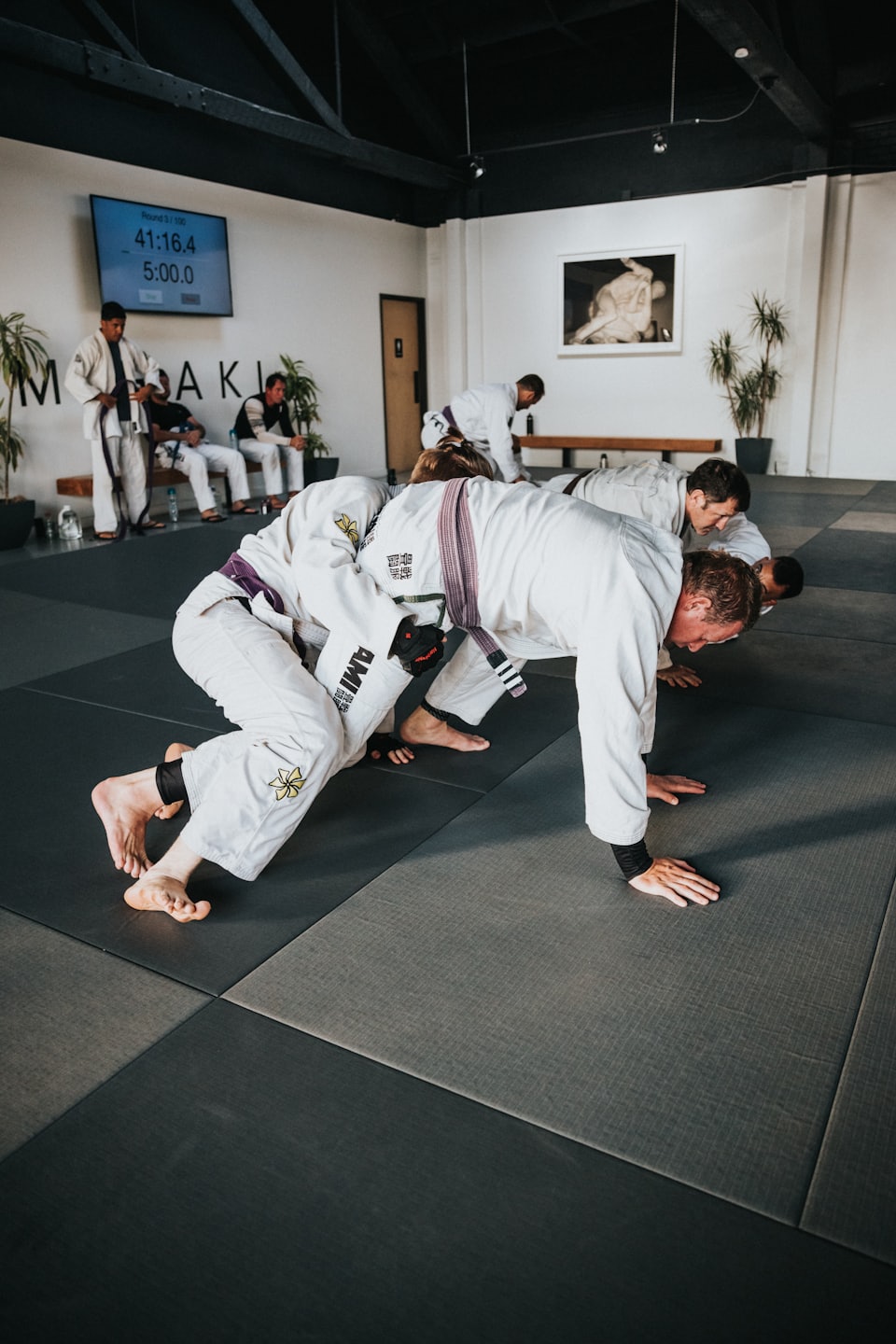
These guys aren’t even thinking about criminals attacking with weapons, so they don’t develop those skills.
It basically comes down to what reason a person has for training in martial arts. Do you want to be as ready as possible to handle someone trying to kill you? If so then the highly effective techniques passed on by the samurai, who were the ultimate masters of combat skills, are the skills that are most effective for practically handling threats against your life. So “combat” martial arts are really just arts focused on handling the most dangerous attacks.
The other question about what is or is not aggressive is hard to address because that is a subjective word. Combat is a balance between energy, and when an assailant attacks you with intense energy is not usually appropriate to be too passive. However springing into action and taking someone down and holding him in a restraint so that he can’t continue fighting might seem shocking to someone who has never seen anything like it, but it won’t really have the negative connotation of aggressive. More likely it will be more like “nipping the situation in the bud.” Rather than a brutish over-reliance on striking to pommel someone until he is knocked out, a common sport methodology, Jūjutsu usually uses a few strikes and then gets the opponent subdued, ending a fight sooner to reduce risk of injury to either person. That isn’t aggressive so much as efficient.
It all boils down to a cost-benefit analysis of time spent training and the resulting skills and knowledge gained for the intended use. If you are dead set on sport martial arts, training at the APMA would not be ideal because most of the techniques we use are against the rules in sport martial arts. And when do you ever see a guy in MMA competitions pull out a knife? If you want to be able to defend against attacks with weapons, sport martial arts are not the most effective way of doing that.